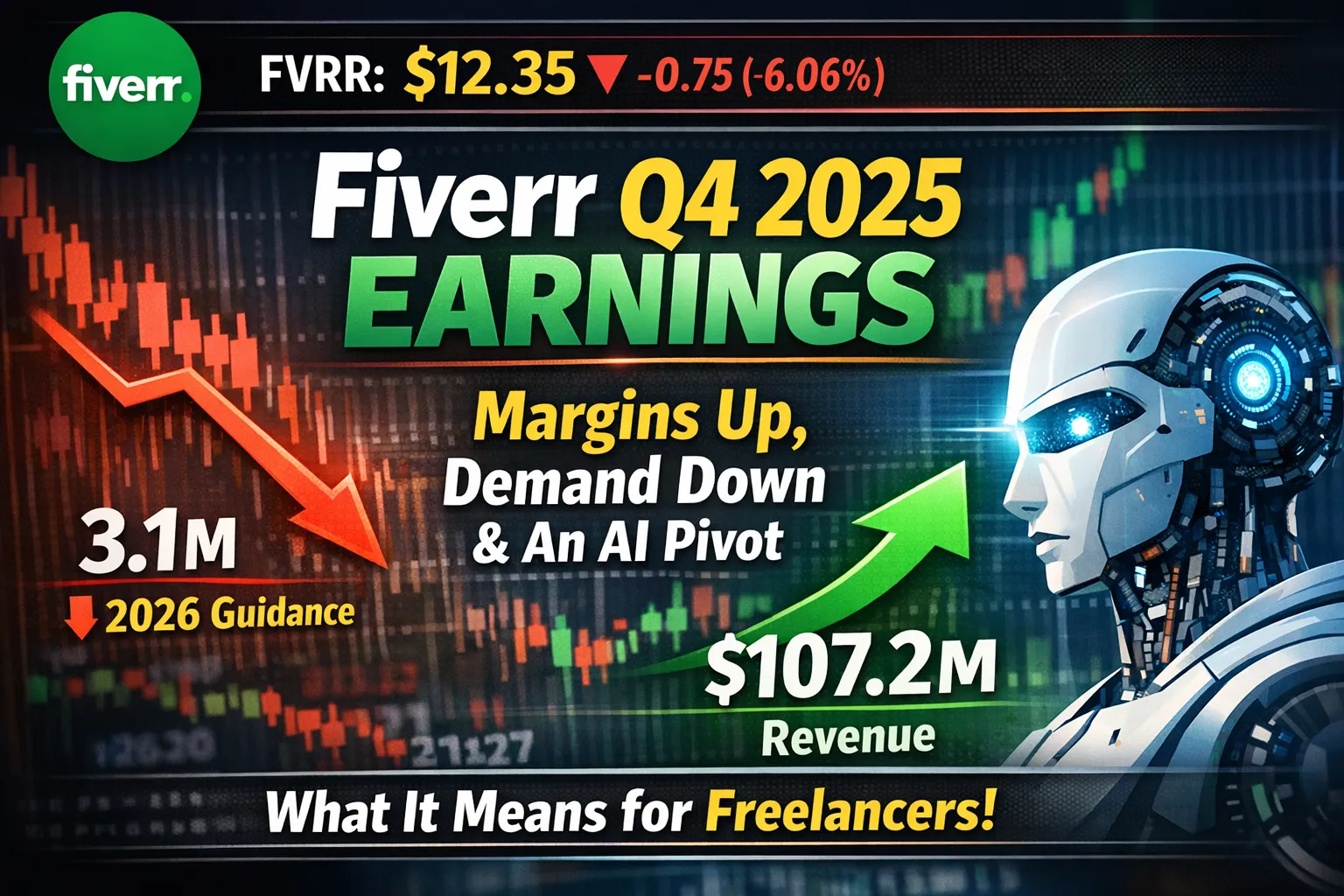
Stock market information for Fiverr International Ltd (FVRR)
- Fiverr International Ltd is a equity in the USA market.
- The price is 12.35 USD currently with a change of -0.75 USD (-0.06%) from the previous close.
- The latest open price was 10.3 USD and the intraday volume is 2626473.
- The intraday high is 12.97 USD and the intraday low is 9.74 USD.
- The latest trade time is Wednesday, February 18, 16:48:11 +0200.
On February 18, 2026, Fiverr reported Q4 2025 and full-year 2025 results. The numbers look “better” if you focus on profitability and higher-value work, and “worse” if you focus on marketplace demand, active buyers, and 2026 guidance. That tension is the story.
Fiverr is basically saying:
- We’re making the business more profitable and more “high-value.”
- Low-end transactional work is under pressure (including from AI).
- 2026 will be a transition year where we invest heavily and accept more volatility.
- If we execute, the payoff is expected later (not immediately in 2026).
Below is the deep dive - and the practical freelancer takeaways.
1) The headline Q4 numbers (quarter ended Dec 31, 2025)
Revenue: $107.2M (up ~3.4% YoY)
Marketplace vs Services
- Marketplace revenue: $71.5M (down ~2.7% YoY)
- Services revenue: $35.6M (up ~18.2% YoY)
Profitability
- Adjusted EBITDA: $26.5M
- Adjusted EBITDA margin: 24.7% (a big YoY improvement)
- Free cash flow: $21.8M (still strong, but down YoY)
Bottom line: Q4 looked solid on margins, but the core marketplace line declined while “Services” carried more of the growth.
2) Full-year 2025: growth came from “Services,” not the classic marketplace
Full-year revenue: $430.9M (up ~10.1% YoY)
But the mix matters:
- Full-year marketplace revenue: $297.5M (down ~1.8% YoY)
- Full-year services revenue: $133.4M (up ~50.9% YoY)
This is a big strategic signal.
Fiverr is less and less “just a marketplace of gigs,” and more a blend of:
- marketplace transactions
- ads and seller tools
- subscriptions / managed experiences
- add-on services that support higher-value work
If you’re a freelancer, this shift affects how you win on the platform: it’s moving from “list a gig and compete on price” toward “build trust + get matched + run bigger outcomes.”
3) The core marketplace is shrinking in buyers, but improving in value per buyer
Fiverr’s key marketplace metrics moved in opposite directions:
- Annual active buyers: 3.1M (down ~13.6% YoY)
- Annual spend per buyer: $342 (up ~13.3% YoY)
- Marketplace take rate: 27.7% (roughly stable)
Translation: fewer buyers are transacting, but the ones who stay are spending more.
This “fewer buyers, higher value” pattern usually happens when a marketplace is:
- pushing upmarket
- prioritizing repeat business
- investing in matching and managed workflows
- letting low-end commoditized categories decline instead of forcing them back with discounts
4) High-value work is growing fast (but it’s still not most of the marketplace)
Fiverr highlighted growth in bigger projects:
- GMV from transactions above $1,000 grew ~22.8% YoY in Q4
- Buyers spending more than $10,000 annually grew (single digits)
But there’s a nuance most people miss:
Even with fast growth, high-value projects are still a minority of total marketplace GMV. That means:
- the “old Fiverr” (lots of smaller transactions) still represents a large portion of activity
- but it’s also the part Fiverr is least excited about optimizing in 2026
So the platform is essentially trying to migrate the business mix - not pretend that everything is already upmarket.
5) Why the stock dropped hard: 2026 guidance reset expectations
The market reaction wasn’t about “did they beat earnings” - it was about the forward outlook.
Guidance given:
- Q1 2026 revenue: $100M to $108M
- Full-year 2026 revenue: $380M to $420M (implying YoY decline)
- Full-year 2026 adjusted EBITDA: $60M to $80M
This is a classic “transition-year” guide:
- revenue range is wide
- growth may be negative
- margins are expected to dip because they’re investing in foundational work
Fiverr also pointed to uncertainty and explicitly said it will deprioritize low-end transaction optimization, which implies more volatility in marketplace revenue in 2026.
6) The “AI shift” is now explicit in Fiverr’s narrative
Fiverr’s CEO framed the current period as a major AI adoption shift.
What they’re really describing (in business terms) is:
- AI compresses simple tasks and makes low-end work easier to replace.
- Buyers still want outcomes, but now they expect faster turnaround and higher-level thinking.
As a result, demand shifts toward:
- specialized work
- judgment and context
- orchestration and delivery
- trust and reliability
This is why Fiverr is leaning into an “agentic economy” story: AI will help navigate complexity, but humans remain critical for outcomes.
Whether you agree with the framing or not, the platform strategy is aligned with it.
7) Leadership changes: Fiverr is reorganizing around the transformation
Fiverr adjusted its leadership structure:
- CFO responsibilities moved to Esti Levy Dadon
- A Chief Business Officer role was created (Jinjin Qian)
- Ofer Katz continues as President, focusing more on strategic investments and M&A
This kind of change usually happens when a company believes:
- execution complexity is increasing
- they need tighter ownership around revenue ops + fulfillment + business operations
- the next phase requires a different internal operating model
8) What this means for freelancers (the part that actually matters)
Here’s what’s likely to change on the ground for sellers/freelancers in 2026 - based on Fiverr’s mix shift and stated priorities.
A) Low-end, transactional categories will feel tougher
If your services are:
- easy to compare
- easy to commoditize
- easy to “AI-replace” at a basic level
- bought mostly by one-time buyers
…you’re more exposed.
Even if you keep getting orders, you may see:
- more price pressure
- more competitors
- more buyer skepticism (“why is this not instant with AI?”)
- fewer casual buyers entering the marketplace
B) High-value freelancers get a tailwind (but must adapt to a new bar)
If you sell:
- complex outcomes
- business-critical work
- specialized expertise
- larger scopes ($1k+ projects)
…Fiverr is trying to send more of that demand your way through better matching and managed workflows.
But the bar changes:
- buyers expect clearer process
- more proof
- faster communication
- stronger delivery systems
- outcome ownership (not just “deliver files”)
C) Repeat buyers become more important than ever
When buyer counts are shrinking, growth comes from:
- repeat spending
- upsells
- subscriptions/retainers
- longer relationships
So for freelancers, “closing the first order” matters less than “turning it into a relationship.”
D) Platform tools may matter more (ads, subscriptions, managed experiences)
As Fiverr’s Services segment grows, it’s a signal that:
- Fiverr wants sellers to use more platform tools
- the “storefront + gig listing only” model is less of the whole story
- the winners will be the ones who understand visibility + conversion + retention inside the platform
9) Practical freelancer playbook (what to do next)
If you want to be on the right side of Fiverr’s 2026 shift, here’s a straightforward approach.
1) Move from “tasks” to “outcomes”
Bad offer: “I will design a logo.”
Better offer: “I will design a brand identity system you can deploy across web, socials, and product - with a 2-round review process and handoff kit.”
Outcome-based offers survive commoditization.
2) Productize your service into tiers that naturally climb above $1,000
Example structure:
- Starter: audit + plan (fast, small)
- Core: implementation (main delivery)
- Scale: optimization + ongoing support (recurring)
This also improves your close rate because buyers can pick a level.
3) Build trust assets that reduce “buyer risk”
- tight portfolio (before/after)
- 3–5 case studies
- a clear onboarding checklist
- a 1-page “how I work” delivery process
- strong expectation-setting on revisions and scope
When Fiverr emphasizes trust + quality, these assets become conversion multipliers.
4) Use AI to accelerate your workflow, not to replace your value
Your edge isn’t “I can generate output.”
Your edge is:
- knowing what to generate
- what to reject
- how to align it with business goals
- how to ship a reliable result
Tell buyers you use AI internally to move faster, but keep the positioning anchored on outcomes and judgment.
5) Push for repeat business deliberately
After delivery:
- propose a “next step” improvement
- offer a small maintenance plan
- offer a quarterly refresh
- offer monitoring/reporting
- create a lightweight retainer option
If the buyer base is shrinking, repeat business is your growth engine.
10) The big picture: Fiverr is choosing a harder path now to (maybe) win later
Fiverr could try to “pump” low-end transactions with discounts and marketing. Instead, they’re signaling the opposite: accept volatility, invest in foundations, move upmarket, and align with how AI changes buyer behavior.
That’s risky - but coherent.
For freelancers, the message is also coherent:
- If you’re selling commoditized tasks, 2026 gets tougher.
- If you sell specialized outcomes and build trust + process, Fiverr is literally trying to build the platform around you.
Reference notes (not part of the copy)
- Q4 / FY 2025 results, revenue mix, profitability, buyer metrics, and 2026 guidance are from Fiverr’s earnings release reprint.
- Additional detail on guidance ranges, margin headwinds, capital allocation and transformation timeline came from the earnings call transcript.
- Market reaction context (large premarket drop tied to weak guidance vs expectations) was reported by Investing.com.