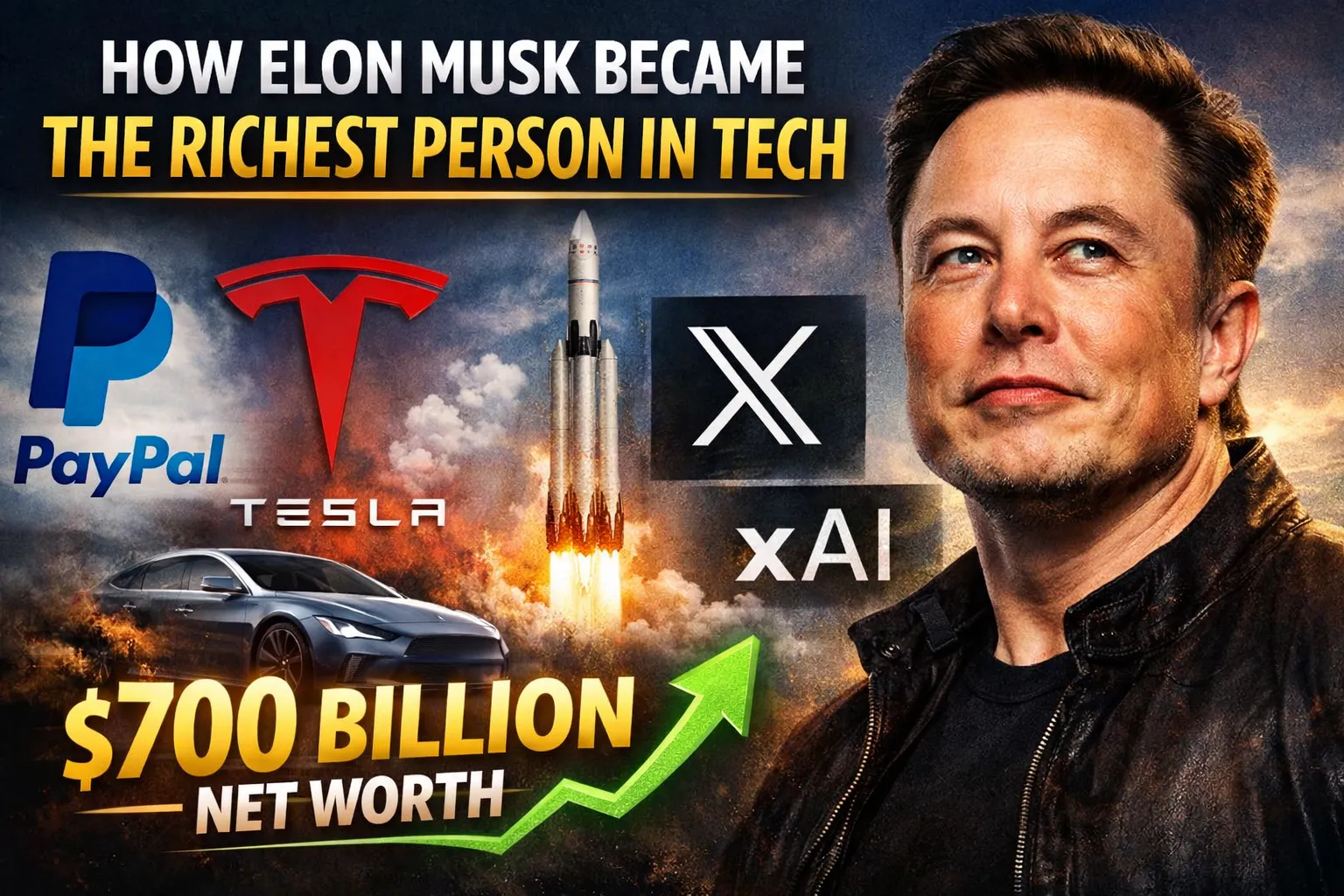
How tech made Elon Musk the richest person: from PayPal to Tesla, SpaceX, X, and xAI
When headlines say Elon Musk reached $700 billion, it sounds like a single event. In reality, it’s the result of 25+ years of compounding tech bets, extreme equity concentration, and timing.
No paycheck. No cash windfall. Just ownership, options, and markets repricing assets.
This is the full story — from early internet software to EVs, rockets, social platforms, and AI.
1. Early internet money: Zip2 and PayPal (1995–2002)
Musk’s journey starts in the late 90s internet boom.
- Zip2 was a city-guide and mapping software company sold in 1999.
This gave Musk his first meaningful capital and independence. - He immediately rolled that money into X.com, an online payments startup that later merged and became PayPal.
- In 2002, PayPal was acquired by eBay, turning Musk into a multimillionaire in his early 30s.
Key takeaway: early liquidity didn’t make him ultra-wealthy — it gave him freedom to take extreme risk.
2. SpaceX: the impossible company that rewrote the curve (2002–today)
After PayPal, Musk didn’t diversify. He concentrated.
He founded SpaceX in 2002 with the goal of making space launch cheaper — something almost everyone considered unrealistic.
- SpaceX nearly failed multiple times in its early years.
- Survival depended on a few successful launches and critical government contracts.
- Over time, SpaceX became dominant in reusable rockets, satellite launches, and orbital infrastructure.
By the mid-2020s, SpaceX had quietly become one of the most valuable private companies in history.
When private secondary sales repriced the company near $800B, Musk’s large ownership stake instantly added hundreds of billions to his net worth on paper.
Key takeaway: private companies don’t move daily — but when they reprice, net worth jumps violently.
3. Tesla: public markets + narrative + leverage (2004–today)
Musk joined Tesla early, funding the company in 2004 and eventually becoming its public face and CEO.
Tesla is where his wealth became visible.
- Tesla’s stock transformed Musk’s holdings into daily mark-to-market wealth.
- As Tesla crossed major milestones (mass EV adoption, profitability, trillion-dollar market cap), Musk’s net worth followed.
- Unlike most CEOs, Musk took minimal salary and focused on equity and options.
The 2018 Tesla compensation plan
One of the biggest accelerators was a long-term performance-based stock-option plan tied to extreme growth milestones.
When courts later reinstated that plan, the options were suddenly worth well over $100B, instantly pushing Musk’s estimated net worth toward the $700B level.
Key takeaway: options + public markets = exponential upside.
4. Twitter → X: distribution over profit (2022–today)
In 2022, Musk acquired Twitter for $44B and later rebranded it to X.
Financially, this wasn’t a short-term win. Strategically, it mattered.
X gave Musk:
- global real-time distribution,
- direct access to public conversation,
- massive data streams.
This move makes more sense when viewed as infrastructure rather than a standalone business.
Key takeaway: not all assets are bought for immediate valuation gains — some are leverage.
5. xAI: the AI leg of the empire (2023–today)
Musk entered the AI race with xAI, positioning it as a direct competitor to other frontier AI labs.
xAI later merged structurally with X, combining:
- distribution (X),
- data,
- and AI model development.
By late 2025, xAI was already being discussed at valuations that would have seemed impossible just two years earlier.
Key takeaway: AI added a new optionality layer to Musk’s net worth.
Why the $700B moment happened now
The “$700B” headline appeared because multiple valuation events stacked together:
- Tesla stock was strong
- A major Tesla stock-option package was reinstated
- SpaceX was repriced dramatically higher in private markets
- xAI began entering mega-valuation territory
Net-worth trackers simply updated the math.
Nothing magical happened overnight — the scoreboard changed.
How tech made him the richest person (the formula)
If you strip away the hype, the pattern is clear:
- Early internet liquidity (PayPal)
- Extreme equity concentration (Tesla, SpaceX)
- Long time horizons (10–20 years per bet)
Operating in sectors with nonlinear upside:
- EVs & autonomy
- Space launch & satellites
- Social distribution
- Artificial intelligence
- Using ownership and options, not salary
This is not a diversification story.
It’s a conviction + leverage + time story.
A takeaway for builders and developers
For anyone building in tech:
- Cash flow keeps you alive.
- Equity is what changes your ceiling.
- Net worth headlines are volatile because they reflect pricing events, not effort.
Elon Musk didn’t “make” $700 billion.
He owned pieces of companies that the world decided were worth that much — at that moment.
And tomorrow, the number can move again.