If you try to find a clean stat like “X billion people work from a computer,” you’ll quickly hit a wall:
- governments track employment, not “computer usage”
- “working from a computer” can mean all-day knowledge work… or 10 minutes on a POS terminal
- the share varies wildly by country (services-heavy vs. agriculture-heavy economies)
So the best way to answer this in 2026 is with reasonable proxies and a transparent estimate.
First: define “working from a computer”
For this article, I’ll use two tiers:
Tier A — Computer-primary workers
People whose job mainly happens on a computer: writing, spreadsheets, design, coding, analytics, support, ops, finance, HR, marketing, product, legal, research.
Tier B — Computer-regular workers
People who use computers as a meaningful part of the job (but not all day): retail systems, logistics scanners + dashboards, admin tasks in healthcare, factory planning terminals, etc.
When most people ask the question, they mean Tier A.
Proxy #1: total global employment (the “base”)
A credible anchor is global employment in the mid-2020s: ~3.5 billion employed people worldwide.
We can back into this using global informality: one widely cited global figure is that 57.8% of workers (more than 2 billion people) were employed informally in 2024. That implies total employment around 3.4–3.7 billion (because “more than 2 billion” is rounded).
So for 2026, using ~3.5B employed as a working baseline is reasonable for estimation purposes.
Proxy #2 (the best one): “jobs exposed to generative AI” ≈ computer-heavy work
Here’s the surprisingly useful shortcut:
Jobs with medium-to-high exposure to generative AI tend to be the same jobs that involve documents, email, analysis, systems, and knowledge workflows — i.e., computer work.
One recent global summary states that 23.8% of workers were in occupations with medium to high exposure to generative AI technologies.
That 23.8% is not “computer workers” by definition — but it’s a strong proxy for Tier A computer-primary work.
What that implies numerically
If global employment is roughly ~3.5B:
23.8% × 3.5B ≈ 0.83B (830 million)
So a defensible estimate is:
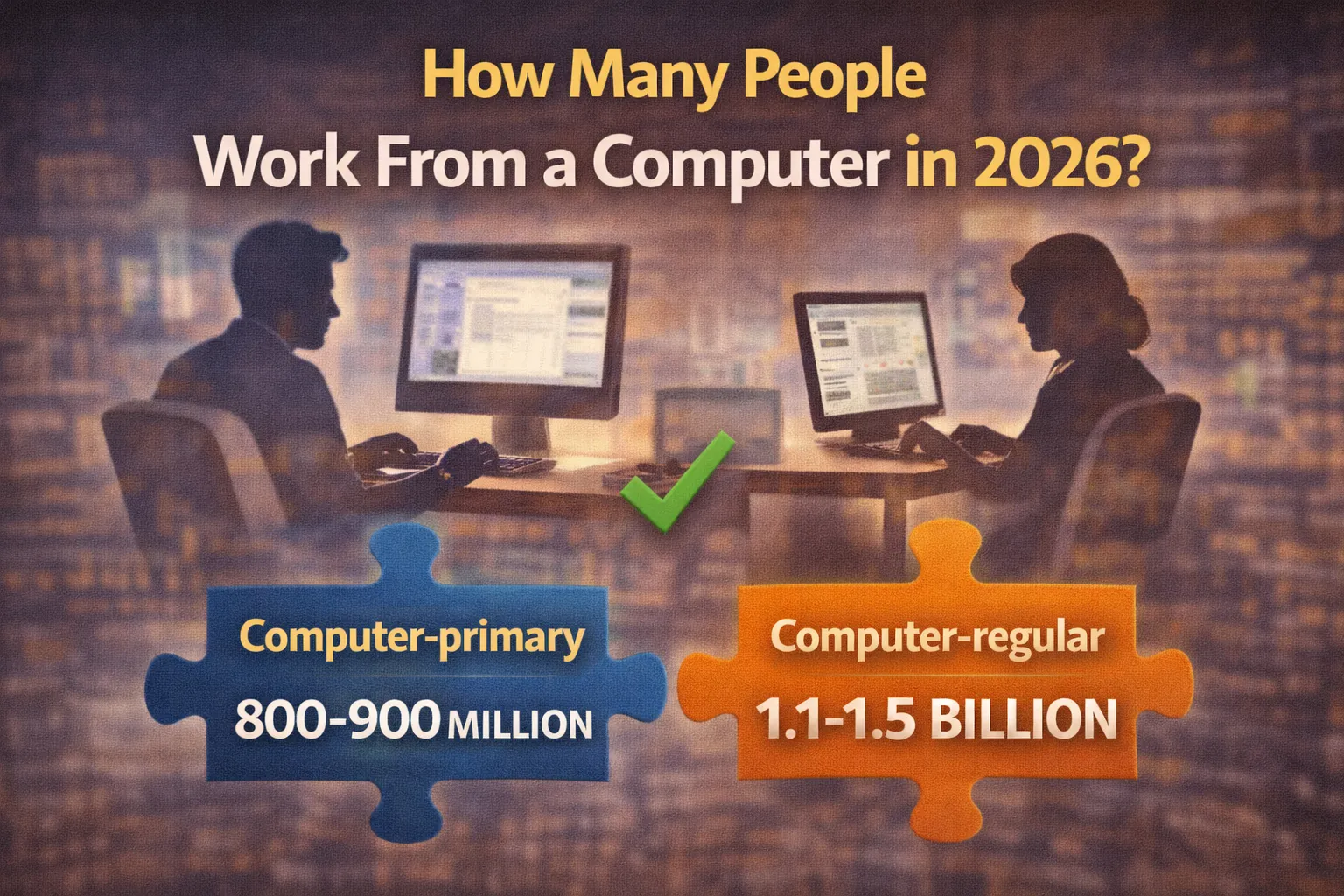
~800–900 million people worldwide are computer-primary workers in 2026.
That’s your Tier A number.
What about Tier B (computer-regular workers)?
Tier B is bigger because many jobs include some computer interaction without being “knowledge work.”
A second proxy is the world’s shift toward services employment. Globally, services are a large and growing share of employment (World Bank’s “employment in services” series tracks this trend). (World Bank Open Data)
But “services” ≠ “computer work” (think hospitality, cleaning, caregiving). So we don’t want to equate them.
A practical way to think about Tier B:
- Tier A (computer-primary): ~0.8–0.9B
- Tier B adds people in operational roles with regular systems use
A reasonable Tier B range is:
~1.1–1.5 billion people who use a computer regularly at work in 2026
(with huge regional variation)
I’m labeling this as an estimate, not a measured statistic — because globally it isn’t directly measured as a single number.
Why the number feels like it’s “everyone” (even if it isn’t)
Two reasons:
- Computer work concentrates online
The people who post, ship software, argue on Twitter/X, and write on Reddit are disproportionately Tier A. - AI made computer work more visible
When a job can be accelerated by AI, it’s usually already digital and document-driven — so the “knowledge work economy” gets more attention than its share of total global employment.
Why this matters for founders and agencies (abzglobal.net angle)
If ~800M+ people are computer-primary workers, that’s the real market behind:
- SaaS tools
- internal dashboards
- automation tools
- AI copilots
- B2B UX expectations (speed, keyboard workflows, search, integrations)
Implications you can use in articles and sales pages
- Your buyer expects software to feel fast and app-like, not like a brochure site.
- “Works on mobile” is important — but for this audience, desktop UX still dominates.
- Features that win are boring and powerful: search, filters, bulk actions, exports, audit trails, permissions, integrations.
The takeaway (simple answer)
Because there’s no single “computer workers” metric, the best 2026 estimate is proxy-based:
- Computer-primary workers (Tier A): ~800–900 million globally
- Computer-regular workers (Tier B): ~1.1–1.5 billion globally
These estimates are consistent with global employment scale and the share of occupations described as medium-to-high exposure to generative AI (a strong proxy for computer-centric roles).