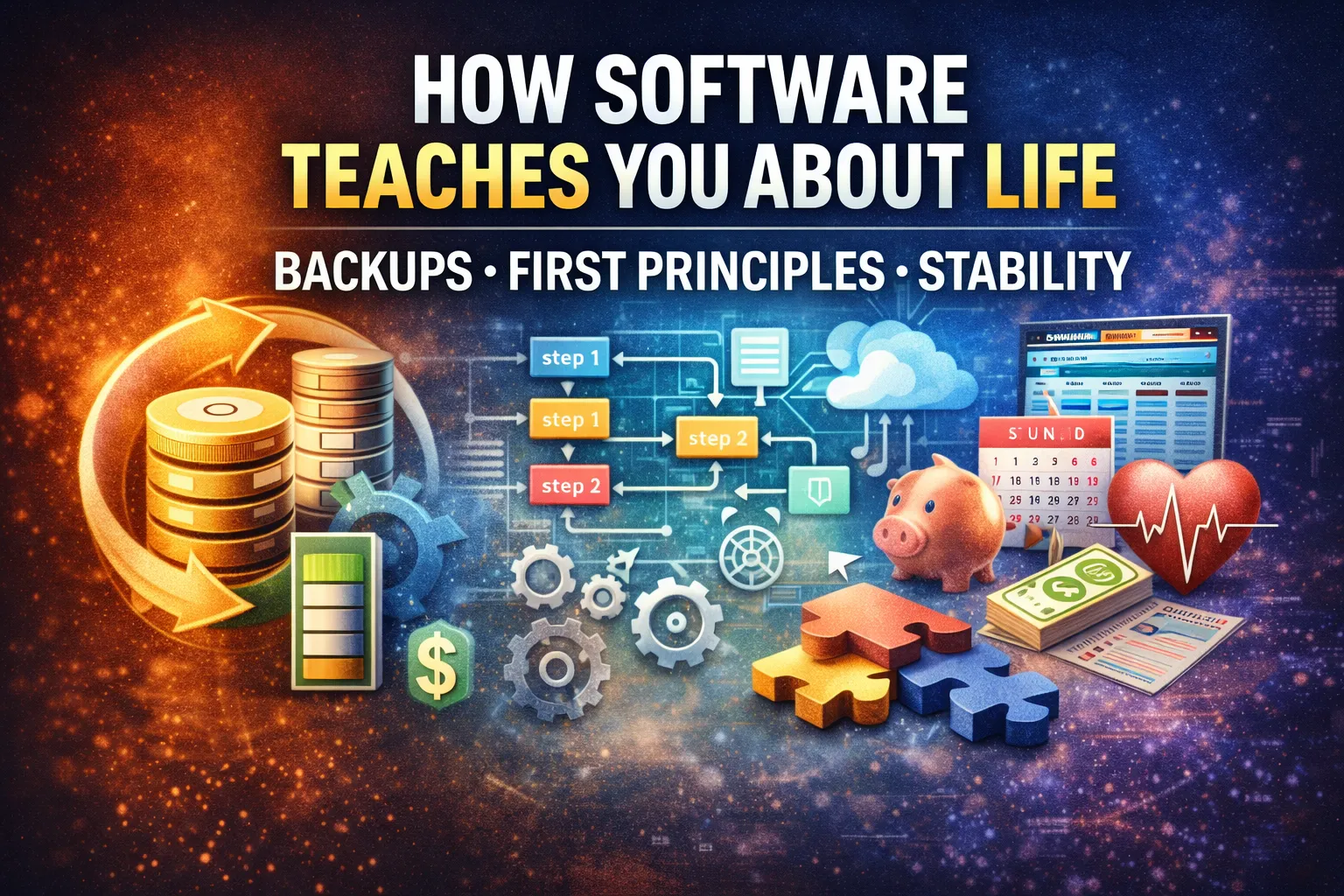
Software is one of the best “life teachers” because it’s brutally honest.
If you ignore fundamentals, things break.
If you don’t prepare for failure, you lose work.
If you build on weak dependencies, your system collapses at the worst time.
And the funny part is: those lessons transfer almost perfectly to real life.
Here are the biggest life principles software quietly teaches you.
1) Backups: assume failure will happen
In software, the question is never “will something fail?”
It’s “what fails first?”
- servers go down
- SSDs die
- people delete things
- APIs change
- accounts get locked
- bugs happen at 2 AM
So professionals build backups:
- database backups
- version history
- snapshots
- redundancy
- rollback plans
Life version
Backups are not pessimism — they’re maturity.
- Save money (financial backup)
- Maintain health (physical backup)
- Build relationships (social backup)
- Keep skills sharp (career backup)
- Document important stuff (information backup)
If you have no backups, small failures become disasters.
2) First principles: know the core parts before you optimize
In software, you can’t “hack your way” past fundamentals.
If you don’t understand:
- data flow
- state
- performance bottlenecks
- security basics
…you can’t build reliable systems.
You can copy-paste code, but eventually you hit a wall.
Life version
First principles are the “core truth” under the noise.
When you feel stuck, ask:
- What is the real problem?
- What actually matters here?
- What is the simplest working solution?
Most people get overwhelmed because they try to solve life at the “framework” level instead of the “truth” level.
Software teaches you:
start with what must be true.
3) Core parts matter more than fancy features
Most software fails because:
- the fundamentals aren’t stable
- the system isn’t maintainable
- the experience is inconsistent
Not because it lacked a fancy feature.
Great products focus on:
- reliability
- usability
- clear workflows
- strong defaults
Life version
Your core parts are:
- sleep
- health
- focus
- relationships
- financial stability
- time management
If these are broken, no “new habit app” or “new strategy” will save you.
Software teaches you:
stability beats novelty.
4) There are multiple ways to solve the same problem
In programming, there are often 10 valid ways to do something:
- different languages
- different architectures
- different tradeoffs
There isn’t always one “correct” answer.
What matters is:
- does it work?
- is it maintainable?
- does it scale?
- can humans understand it?
Life version
People waste years trying to find the “one perfect path.”
But most paths are valid if they match your constraints:
- your energy
- your goals
- your environment
- your personality
- your season of life
Software teaches you:
optimize for tradeoffs, not perfection.
5) Too many dependencies makes you fragile
In software, dependencies are great… until they aren’t.
- one library gets abandoned
- a vendor changes pricing
- an API breaks
- a package becomes insecure
- a service goes down
The more your system depends on external pieces, the more fragile it becomes.
Life version
The same thing happens when your life depends on too many external conditions:
- your productivity depends on motivation
- your peace depends on other people’s approval
- your income depends on one client
- your stability depends on one platform
- your confidence depends on “perfect timing”
Software teaches you:
reduce single points of failure.
6) Make dependencies reliable, or own the critical parts
In engineering, you either:
- trust dependencies that are stable and maintained
- or you own the critical layers yourself
That’s why serious systems:
- use proven infrastructure
- add redundancy
- have fallback plans
- avoid “random” packages
Life version
You don’t need to “do everything yourself.”
But you do need to be careful what your life relies on.
Examples:
- if your business relies on one platform, build an email list
- if your career relies on one tool, learn fundamentals
- if your schedule relies on chaos, create a system
Trust external systems — but build your own stability underneath.
7) Separation of concerns: keep life systems from bleeding into each other
In software, separation of concerns is huge:
- UI is not business logic
- business logic is not data storage
- data storage is not networking
You isolate components so one failure doesn’t destroy everything.
Life version
Most stress comes from “everything bleeding into everything.”
- work spills into personal life
- personal chaos spills into work
- finances spill into relationships
- relationships spill into focus
Separation of concerns in life looks like:
- clear routines
- boundaries
- time blocks
- “work mode” vs “rest mode”
- dedicated spaces (even if it’s just a corner of your room)
Software teaches you:
boundaries create stability.
8) Refactoring: improve systems without needing a complete restart
In software, you rarely delete everything and start over.
You refactor:
- clean messy parts
- simplify flows
- remove unused code
- improve naming and structure
Life version
You don’t need a “new life.”
You often just need a refactor:
- remove one bad habit
- simplify your schedule
- rebuild your morning routine
- reduce commitments
- stop doing what doesn’t work
Small refactors compound into a better life system.
Final takeaway: treat your life like a reliable system
Software teaches a mature mindset:
- expect failure, design for it (backups)
- focus on fundamentals (first principles)
- keep core parts strong (stability)
- avoid fragility (too many dependencies)
- isolate important areas (separation of concerns)
- improve incrementally (refactoring)
That mindset isn’t just for engineers.
It’s a blueprint for living calmer, smarter, and more resilient.