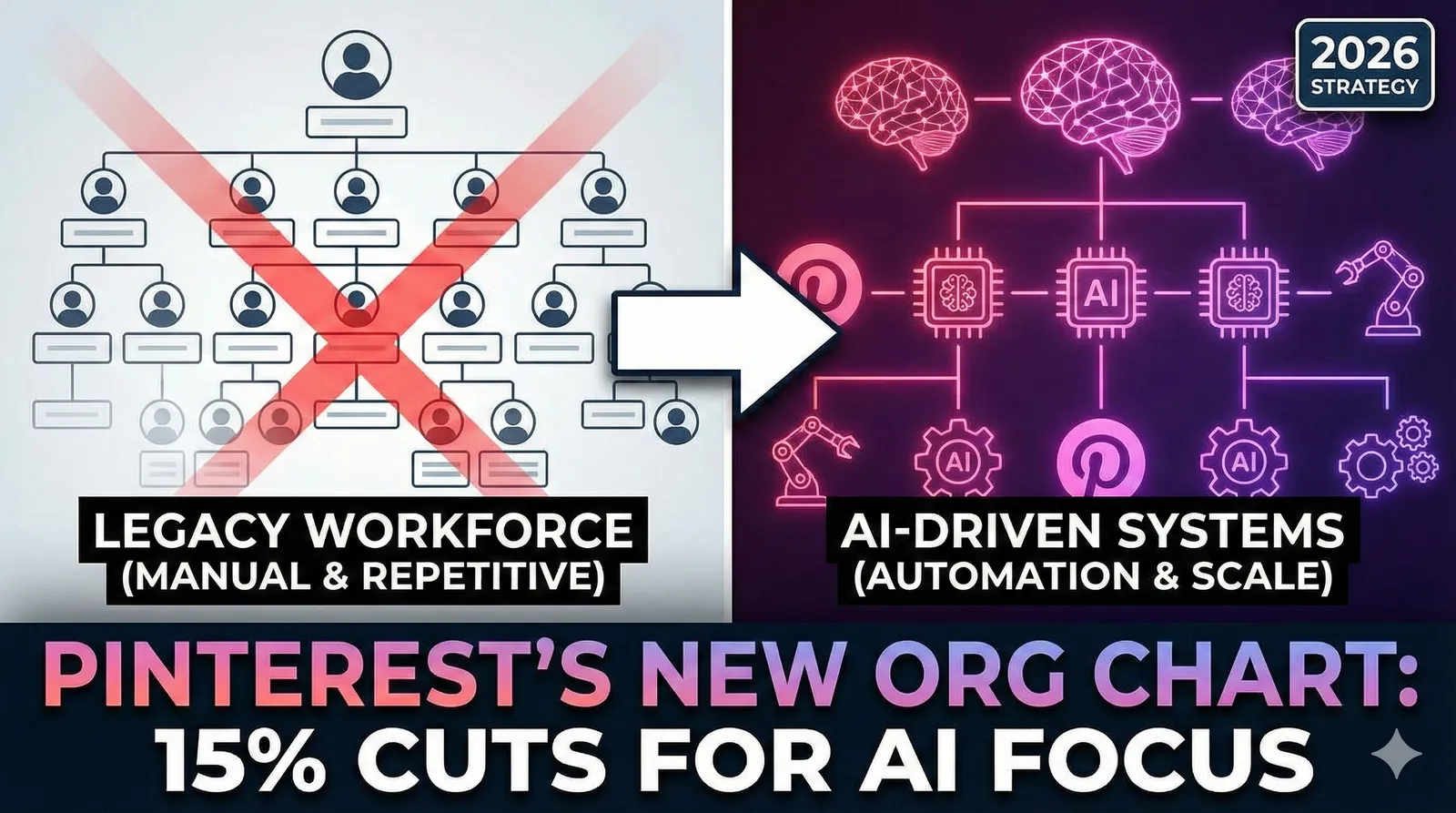
Pinterest just announced a restructuring that includes cutting under ~15% of its workforce (roughly ~700 roles, based on its last reported full-time headcount), while reallocating resources toward AI-focused teams and reducing office space. The plan is expected to run through late September 2026, with estimated pre-tax restructuring charges of about $35M–$45M.
If you’re a founder or product leader, the headline shouldn’t just be “AI layoffs.” The real story is the org chart shift that’s becoming common across tech:
Fewer people doing manual, repetitive, or legacy work - more people building automation, AI-driven systems, and AI-enhanced product experiences.
Let’s break down what changed, why this happens, and what you can learn from it.
1) What changed at Pinterest
From public reporting and the company’s filing:
- Pinterest said it will cut less than ~15% of its workforce as part of a broader restructuring.
- The company said it’s reallocating resources to AI-focused roles and teams and prioritizing AI-powered products and capabilities.
- The restructuring is expected to be largely completed by the end of September 2026.
- Pinterest also mentioned reducing office space, a common move when teams shrink or hiring shifts to different locations.
- Estimated pre-tax charges for the restructuring: ~$35M–$45M.
That combination is the pattern you’re seeing more often in 2026: headcount down, AI investment up, real estate down.
2) Why “AI focus” often means layoffs (the real mechanics)
This isn’t a moral story. It’s an operating-model story.
A) Automation compresses labor in predictable areas
When a company pushes AI into workflows, the first places that “shrink” are:
- manual content operations and review work
- repetitive internal support tasks
- routine analytics/reporting
- legacy product maintenance where ROI is declining
- sales/marketing execution work that becomes more automated
You don’t need AI to be perfect to cause job compression - you need it to be “good enough” to reduce hours per outcome.
B) AI forces a portfolio decision: “What do we stop doing?”
Real AI investment isn’t a feature toggle. It competes for:
- engineers
- compute budget
- product leadership attention
- data infrastructure
- privacy/security work
To fund that, leadership cuts or de-prioritizes projects that don’t match the new direction.
That’s why AI restructures are almost always paired with layoffs: you can’t “do everything + also rebuild around AI” without blowing up cost structure.
C) The org chart changes shape
The classic shift looks like:
Before:
- many teams shipping many small things
- lots of coordination and manual steps
- maintenance and “keeping the lights on” consumes talent
After:
- fewer teams, bigger mandates
- heavy platform/infrastructure + automation
- more emphasis on leverage: systems that scale output per person
This is the “new org chart” story.
3) What this implies for Pinterest’s product direction
Even without insider details, the direction is straightforward:
A) More AI in discovery and shopping flows
Pinterest has been pushing toward the idea of becoming an AI-powered shopping and discovery assistant in addition to a visual inspiration platform.
So you can expect:
- smarter search and recommendations
- more automated product tagging and enrichment
- ad and commerce tooling that leans on AI to increase conversion
B) More automation in advertising operations
Advertisers want results with less manual setup. AI helps the platform:
- auto-optimize campaigns
- generate creative variants
- improve targeting/relevance signals
This typically reduces the need for some manual operational roles while increasing demand for platform engineers and ML/product specialists.
4) What founders can learn: focus, margin, and automation
This is the most important part for abzglobal.net readers.
Lesson 1: AI is not “add a chatbot.” It’s a reallocation strategy.
If your AI initiative doesn’t force you to answer “what stops,” it’s probably not real yet.
Founder question to ask:
- What do we stop building, stop supporting, or stop manually doing - because AI changes the economics?
Lesson 2: “Output per employee” is the new KPI
The quiet goal behind most AI restructures:
- fewer people
- higher total output
- better margins
If you build SaaS, start measuring:
- support tickets per user (and automation rate)
- onboarding completion time
- time-to-value
- cost per deliverable feature (including AI inference costs)
Lesson 3: Automate internal workflows before you automate the customer
A lot of teams rush to ship “AI features” while internal operations stay manual.
The fastest ROI usually comes from:
- AI-assisted customer support triage
- internal knowledge base search
- QA automation and test generation
- sales ops summarization and CRM hygiene
- content repurposing pipelines
Lesson 4: Your roadmap should shift from “features” to “systems”
In the AI era, the compounding advantage comes from:
- data quality
- feedback loops
- evaluation harnesses
- safe deployment
- observability (cost, latency, failure cases)
If your roadmap is still “feature after feature,” AI will feel expensive and chaotic.
5) A practical playbook for product teams right now
If you’re building in 2026, here’s the “AI focus without chaos” checklist:
- Choose 1–2 AI bets only (not ten experiments)
- Make AI async by default (queue jobs; don’t block core UX)
- Cache and reuse outputs (summaries and tags should not be regenerated constantly)
- Build graceful fallback (product still works when AI fails)
- Track AI cost per feature (not just “monthly AI spend”)
- Automate internal workflows first (biggest ROI, lowest user risk)
This is how you get the leverage without turning your product into a fragile demo.
The takeaway
Pinterest’s move is a clean example of a broader 2026 pattern:
When companies say they’re shifting to AI, they’re often changing the org chart to fund it - and that usually means layoffs, fewer legacy commitments, and heavier investment in automation and AI-powered product capabilities.
For founders, the message isn’t “copy layoffs.” It’s:
- AI strategy requires focus
- focus requires tradeoffs
- and the winners build systems that scale output per person