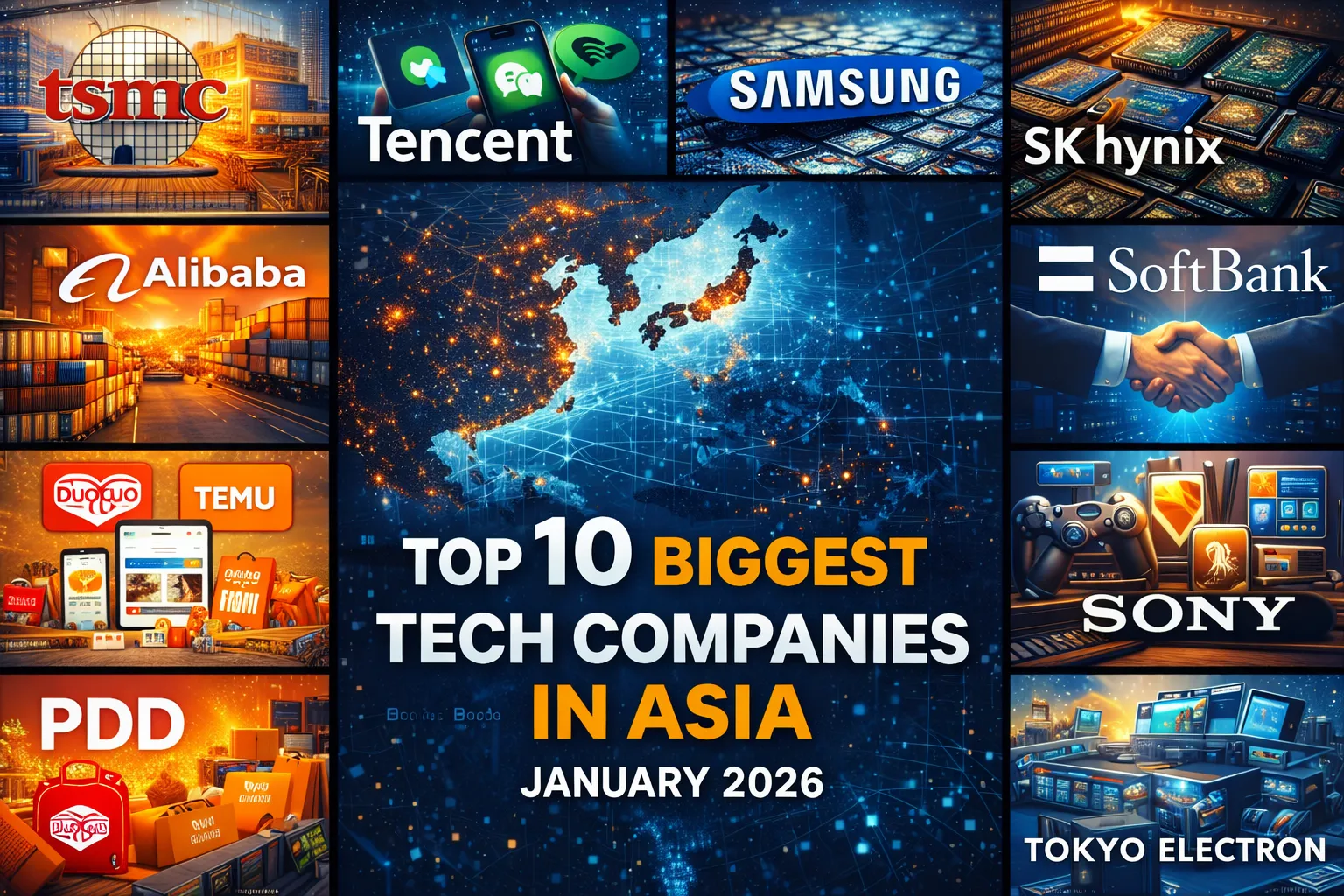
Asia’s “big tech” looks different from the U.S. It’s not just software platforms — it’s semiconductors, electronics, supply-chain infrastructure, and consumer ecosystems operating at massive scale.
This article ranks the largest publicly traded tech companies headquartered in Asia by market capitalization, using a January 2026 snapshot. Market caps change daily, so consider this a point-in-time view.
1) TSMC (Taiwan) — ~$1.657T
TSMC is the most important manufacturing company in modern technology. If you use an iPhone, a flagship Android device, a GPU, or an AI accelerator, there’s a very high chance TSMC manufactured the chip.
What they do
- Contract manufacturing (foundry) for advanced semiconductors, including leading-edge process nodes.
Why they’re so valuable
- TSMC is the factory behind many of the world’s most valuable chip designers.
- AI demand doesn’t just require more chips, but more advanced chips, which strengthens TSMC’s pricing power.
What to watch
- Geopolitical risk around Taiwan.
- Semiconductor capital-expenditure cycles.
2) Tencent (China) — ~$727B
Tencent is China’s most powerful platform ecosystem, deeply embedded into everyday digital life.
What they do
- WeChat / Weixin super-app (messaging, payments, mini-programs)
- One of the world’s largest gaming publishers
- Cloud and enterprise software services
Why they’re so valuable
- WeChat acts as identity, distribution, payments, and services in one platform.
- Gaming provides strong recurring cash flows.
What to watch
- Regulatory pressure.
- Monetization limits in certain content categories.
3) Samsung Electronics (South Korea) — ~$638B
Samsung is one of the few companies in the world that competes simultaneously in semiconductors, devices, and displays.
What they do
- Memory and logic semiconductors
- Smartphones and consumer electronics
- Displays and components
Why they’re so valuable
- Strong exposure to AI-driven memory demand.
- Massive global device distribution that enables AI feature rollout at scale.
4) Alibaba (China) — ~$372B
Alibaba remains a core pillar of Asian commerce and cloud infrastructure.
What they do
- E-commerce marketplaces and merchant tooling
- Logistics ecosystem
- Cloud computing and enterprise services
Why they’re so valuable
- Enormous merchant and consumer network.
- Platform economics combining data, payments, logistics, and distribution.
What to watch
- Intense domestic competition.
- Cloud margin pressure.
5) SK hynix (South Korea) — ~$332B
SK hynix is one of the biggest beneficiaries of the AI infrastructure cycle.
What they do
- DRAM and NAND memory
- High-bandwidth memory used in AI servers
Why they’re so valuable
- AI servers consume significantly more memory per unit.
- Premium memory products have driven higher margins in the current cycle.
What to watch
- Memory market cyclicality.
- Supply expansions that could pressure pricing.
6) SoftBank Group (Japan) — ~$168B
SoftBank is a technology investment group rather than a traditional product company.
What they do
- Strategic investments across technology and AI
- Holding company for major tech stakes
Why they’re so valuable
- High optionality tied to AI investments.
- Market perception swings heavily with AI strategy and portfolio performance.
7) PDD Holdings (China) — ~$164B
PDD (Pinduoduo / Temu) is a software-driven commerce company built around recommendation and price optimization.
What they do
- E-commerce platforms optimized for engagement and value
- Cross-border expansion via Temu
Why they’re so valuable
- Strong execution in performance-based commerce.
- Ability to generate significant cash when growth loops work.
What to watch
- Margin pressure from logistics and promotions.
- Regulatory and cross-border trade risks.
8) Sony (Japan) — ~$154B
Sony is a rare hybrid of gaming, content, and technology infrastructure.
What they do
- PlayStation ecosystem (hardware, software, subscriptions)
- Music and film entertainment
- Imaging sensors used across the tech industry
Why they’re so valuable
- Gaming operates as a platform with recurring monetization.
- Imaging sensors are a critical component in modern devices.
9) Xiaomi (China) — ~$135B
Xiaomi is a consumer tech ecosystem company built on scale.
What they do
- Smartphones
- IoT device ecosystem
- Software and services layered on top of hardware distribution
Why they’re so valuable
- Ecosystem strategy: devices create distribution, services improve margins.
- Strong presence in price-sensitive global markets.
10) Tokyo Electron (Japan) — ~$108B
Tokyo Electron is a critical supplier of semiconductor manufacturing equipment.
What they do
- Tools used in chip fabrication and advanced manufacturing processes
Why they’re so valuable
- When global chip capacity expands, equipment suppliers benefit.
- Structural demand for more complex manufacturing steps over time.
What this top 10 says about Asian tech
The pattern is clear:
- Semiconductor and manufacturing dominance (TSMC, Samsung, SK hynix, Tokyo Electron)
- Platform ecosystems (Tencent, Alibaba, PDD)
- Consumer distribution at massive scale (Samsung, Xiaomi)
- Entertainment platforms with recurring revenue (Sony)
- AI-driven capital allocation and investment leverage (SoftBank)
Asia’s biggest tech winners tend to sit closest to physical production and supply chains, not just the application layer.
If private companies were included
The biggest missing name would be ByteDance, the owner of TikTok and Douyin. As a private company, it doesn’t have a public market cap, but private-market valuations reported in recent years place it among the very largest tech companies globally.
If included, ByteDance would likely rank in the top 3 to top 5 depending on valuation assumptions.